A designer has a lobby opening in ten weeks. The brief calls for a custom rug: the property's logo worked into a medallion, a colourway matched to the FF&E palette, a size that fills the space properly rather than fitting a standard roll width. Hand-knotted is out of the question at that timeline. A good hand-knotted rug takes months. Hand-tufted can hit ten weeks. This is the reason hand-tufted exists as a commercial product category, and understanding it properly starts with the timeline problem it was built to solve.
What Hand-Tufted Actually Means
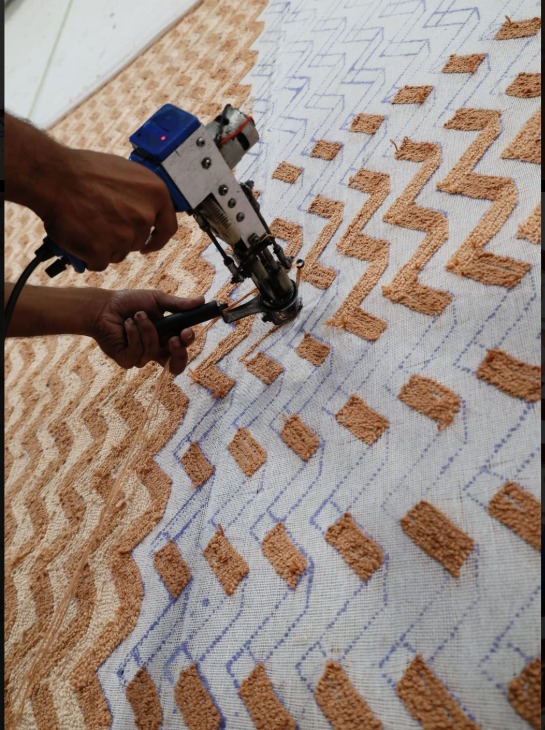
Hand-tufted is a construction method. A technician uses a hand-held tufting gun to punch pile yarns through a stretched canvas backing, following a design that has been transferred onto the canvas surface. The gun drives each tuft in precisely, row by row, guided by the artwork beneath. When the pile surface is complete, the canvas is backed with latex to lock every tuft in place, and a secondary fabric backing is applied over the latex for structure and to give the rug a clean underside.
The result is a rug whose pile surface has the hand-placed quality of skilled craft, because it is. The tufting gun is a tool, not a machine: a person is directing every tuft, working to the design, making decisions about pile direction and density across the surface. The difference between a well-made hand-tufted rug and a poorly made one is the skill of the people doing the work and the quality of the yarns and backing materials they are working with.
Hand-tufted is not hand-knotted. The two are different constructions with different structural properties, different lead times, and different appropriate uses. That distinction matters and is covered in more detail below.
Why It Is the Standard for Custom Hospitality Rugs
The hospitality industry has converged on hand-tufted as the default construction for custom rugs in hotels for three reasons: design flexibility, manageable lead times, and a price point that is viable at the sizes the industry actually needs.
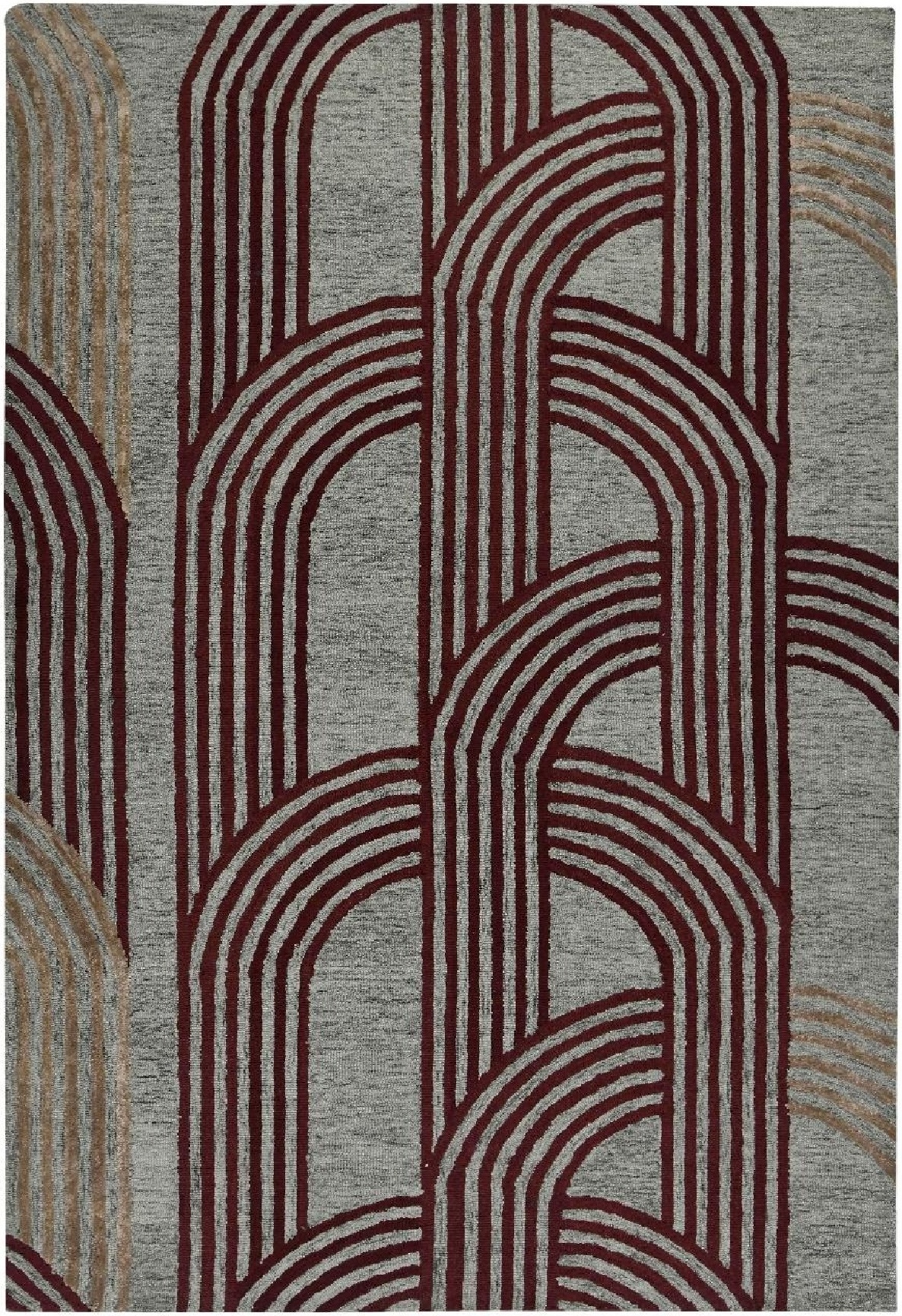
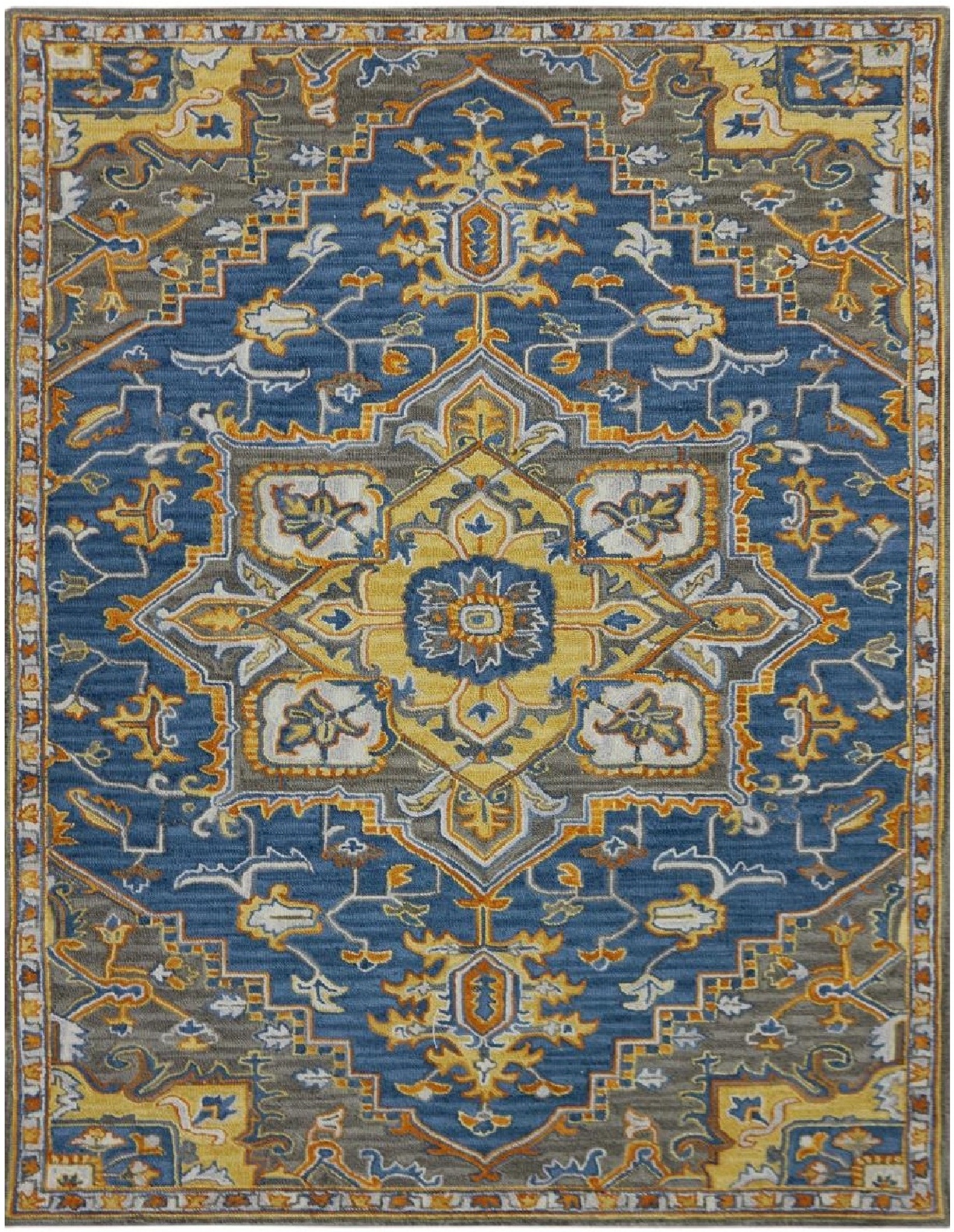
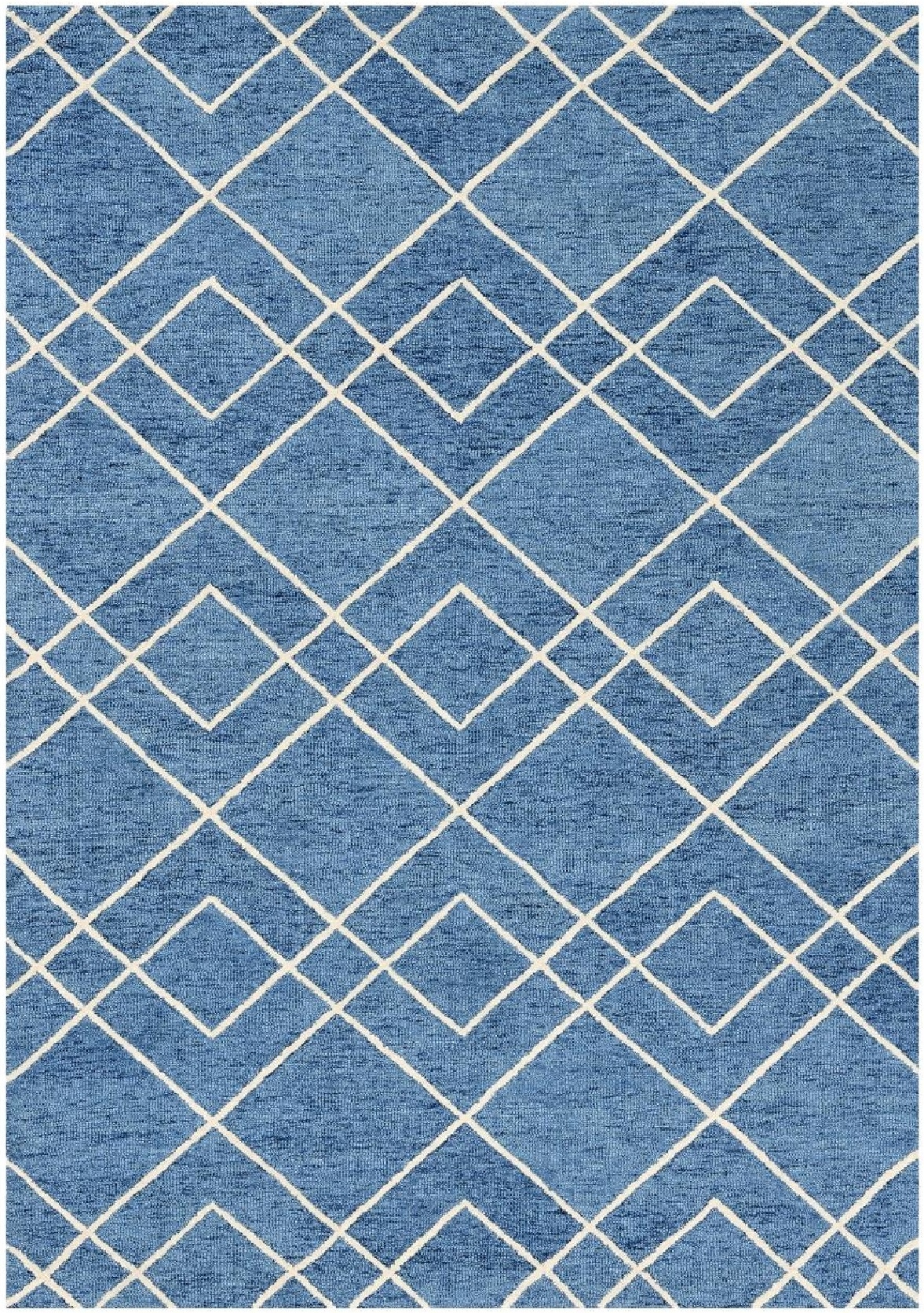
Design flexibility is the first reason. A hand-tufted rug is made from your artwork. Any design that can be transferred onto a canvas can be tufted into a rug: logos, medallions, geometric patterns, abstracts, custom colour fields, bespoke borders. There is no constraint imposed by a loom or a repeat structure. The pile can be cut to a uniform height for a flat, clean surface, or carved and sculpted at different heights to create texture and dimension within the design. Pile can be looped (loop pile) or cut (cut pile), or both within the same rug, which gives designers a range of surface effects that other constructions cannot deliver.
Lead time is the second reason. A hand-tufted rug at hospitality scale, a 3 x 5 metre lobby piece, can be completed in 8 to 12 weeks from artwork approval. Hand-knotted at the same size takes four to eight months or longer. For a project team managing a hotel opening with a fixed date, that difference is decisive.
Price is the third reason. Hand-tufted is more expensive than machine-made broadloom but considerably less expensive than hand-knotted at equivalent sizes. For a signature lobby rug that will be replaced on a seven to ten year cycle as the property refreshes its interior, the hand-tufted price point is appropriate for the use and the lifecycle.
"The physical sample is not optional. Colours on screen and colours in wool are different things. You approve the yarn sample, not the digital render, before production begins."
Materials: Wool, Viscose, and the Blends
The pile yarn is the primary material decision in a hand-tufted rug specification. The most common options in hospitality custom work are wool, viscose, and blends of the two.
Wool is the benchmark for a quality custom rug. It takes dye well, holds colour over time, has natural resilience, and its surface reflects light in the warm, slightly varied way that gives a hand-made rug its character. A wool pile recovers from compression, which matters in a lobby where a rug is walked across many times a day. In Indian conditions, wool's natural moisture management also performs well.
Viscose (sometimes called art silk, or bamboo silk when derived from bamboo fibre) is used for its sheen. Viscose pile reflects light intensely and gives a rug a luxurious visual quality that wool does not. The trade-off is durability: viscose is a relatively fragile fibre that shows traffic wear faster than wool and does not respond well to moisture. In a lobby rug, a small percentage of viscose used to highlight specific elements of a design (the centre of a medallion, a border accent) is a good choice. A rug made primarily from viscose for a high-traffic location is a mistake that will be visible within 18 months.
Wool-viscose blends are common in hospitality work precisely because they balance the two properties: a high-wool content for structural resilience and a viscose element for visual depth. A typical specification for a lobby rug might be 80% wool, 20% viscose.
The Process: From Brief to Delivery
Knowing the steps helps a designer or project manager plan the timeline and know where the non-negotiable hold points are.
Brief and Artwork
The process begins with a design brief: dimensions, colourway reference, design concept or artwork. The more resolved the artwork at this stage, the fewer revision cycles before production. A rough sketch is a starting point; a resolved design file saves time. Dimensions should be confirmed at this stage, not adjusted later.
Design Development
The artwork is rendered as a production-ready file and mapped to the yarn palette available. Colours are translated from the design reference to specific yarn shades. At this stage the designer sees a digital representation of the rug in the proposed colourway and can request adjustments before yarns are ordered.
Physical Sample (Non-Negotiable)
A physical sample swatch is produced before full production begins. This is not a formality. Colours in wool yarn do not look the same as colours on a screen, and the pile texture affects how a colour reads in different lighting. The sample is what you approve, not the digital render. Approving remotely based on photographs is a risk that sometimes results in a full rug being remade.
Production
Once the sample is approved, yarns are ordered and production begins. The canvas is stretched, the design transferred, and tufting begins. For a 3 x 5 metre lobby rug in a medium-complexity design, tufting typically takes three to four weeks. Backing and finishing add another one to two weeks.
Quality Check and Dispatch
The finished rug is inspected, cleaned, and rolled for shipping. A production photograph is sent to the buyer before dispatch. Delivery to Indian locations takes one to two weeks from the weaving facility. Total elapsed time from brief to delivery, assuming a resolved design and one sample revision: eight to twelve weeks.
Hand-Tufted vs Hand-Knotted: The Actual Difference
The two terms are used interchangeably by people who have not specified rugs before, and they should not be. The constructions are fundamentally different, and choosing between them is a decision with real consequences for timeline, price, and the character of the finished piece.
| Criterion | Hand-Tufted | Hand-Knotted |
|---|---|---|
| Construction | Tufting gun, latex backing | Individual knots tied to warp threads |
| Lead time (3×5m) | 8–12 weeks | 4–8 months or longer |
| Price (equivalent size) | Lower | Higher (significantly) |
| Design flexibility | Very high — any artwork | Very high — any artwork |
| Structural durability | Good (backing-dependent) | Exceptional — can last generations |
| Backing visible on underside | Yes — fabric backing applied | No — woven from front to back |
| Right for lobby opening in 10 weeks | Yes | No |
| Right for a 20-year heirloom piece | Possible with quality materials | Yes |
For most hospitality custom rug briefs, hand-tufted is the right answer. For a collector-quality piece, a heritage property rug meant to last decades, or a very high value space where the investment in hand-knotted is warranted, hand-knotted is worth considering despite the timeline and cost. The two are not substitutes; they are different products for different purposes.
Where Custom Rugs Get Specified
The primary locations for custom hand-tufted rugs in hospitality are lobby reception areas, restaurant dining rooms, and branded suites where the property wants a floor piece that belongs to that space rather than a generic product. A logo medallion in a hotel lobby or a custom-coloured geometric for a rooftop restaurant are the most common briefs.
In corporate settings, the boardroom and executive reception are natural locations. A custom rug in a company colourway, with a subtle geometric that references the brand identity, reads as considered rather than off-the-shelf in a way that even a premium stock rug cannot replicate.
Residential applications are also significant: a custom rug for a significant living space, a bedroom suite, or a dining room in a high-end residential project. The process is identical to a hospitality brief; only the scale and the brief change.
What to Ask Before You Brief a Supplier
Questions worth asking any custom rug supplier before committing to a brief:
- Do you provide a physical sample before production? Any supplier who skips this step is asking you to approve a full rug based on a screen render. Do not accept that arrangement.
- What is the pile construction? Cut pile, loop pile, or carved? Each gives a different surface quality and the right choice depends on the design and the use.
- What yarn are you using? Ask for wool content percentage and confirm whether any viscose is in the mix. If it is, ask what percentage and where it appears in the design.
- What is the backing specification? A quality hand-tufted rug uses a double backing: latex over the pile canvas, with a secondary woven or non-woven fabric backing over the latex. A single-layer backing is a sign of a cheaper product.
- Can you provide production photographs before dispatch? A straightforward request that any reputable supplier should be able to accommodate.
- What is the actual lead time from sample approval, not from brief submission? The timeline that matters starts when the sample is approved.
Custom rugs. Built from your brief.
Anchorline sources custom hand-tufted and hand-knotted rugs for architects and designers specifying hospitality, corporate, and residential interiors. We work from your design or sketch, through physical sample approval, to delivery at your project site.
Every brief is quoted with confirmed lead time, yarn specification, and backing details before production begins. Physical samples are standard, not optional. We do not begin production without sample sign-off.
- Any dimensions, any shape
- Custom colourway from your palette
- Wool, wool-viscose, or pure viscose pile
- Physical sample before production
- Lead time confirmed per brief
- Pan-India project delivery
Interested in custom rug sourcing? See the full Bespoke & Custom section on our homepage for a complete overview of our white glove service for hospitality projects.